Thursday, October 7, 2010

LITA National Forum 2010

I attended the LITA National Forum 2010 this past weekend. I presented with Andy Ingham of UNC Chapel Hill on Shibboleth and InCommon. As a whole, the forum had a very relevant mix of topics for Johns Hopkins libraries. The most important and relevant topics I will report on are mobile web design, web site redesign, OCLC’s WMS, promoting open source software through the cloud, and IT organization in libraries. I’ll report on each of these in some detail, but also provide a brief synopsis below.

OCLC’s WMS (Web-Scale Management System) exists and is in use by a handful of early adopters. Feedback was very positive, especially in terms of cost savings due to shared data. This system is here and now and worthy of evaluation.

There were a few presentations on mobile design. Diane Butler from Rice University provided some very detailed analysis, based on actual usage and on survey, as to what are the most used, needed, and desired mobile functions for libraries.

Justin Blum, from University of Nevada, Reno, presented on web redesign. His presentation focused on what made for a successful approach and process to a web redesign in the libraries.

Michael Klein presented on promoting open source projects through the cloud. OSU is spinning up demonstration/evaluation versions of Library a la Carte through cloud service providers. This promotes adoption of the open source software. Could this work for the Blacklight community? Maybe.

Joan Smith, from Emory University, discussed IT reorganization in brief, and talked in more detail about their Agile methodology and project management.

On the Go: What your users really want
Diane Butler – Rice University

Diane presented on Rice’s mobile web design. They’re a pretty small university. Soup to nuts, they did this in 4 months. Their mobile web site is m.library.rice.edu. They used iWebkit. One feature in particular that I think they did a good job with is floor plans. They are attractive and useful in a mobile context. They don’t have GPS, but that is ok.
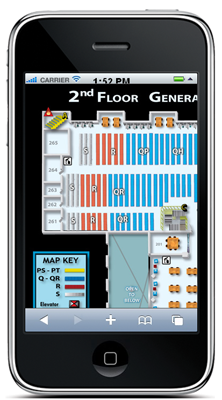
In their process, they very deliberately started tracking usage, as well as planned surveys. These assessment techniques allowed them to analyze what was the most used, most needed and most desired functionality for their users. The most desirable functionality includes search, floorplans, hours, lab availability, GPS navigation, and reserving group study rooms.

Things that were not very well received were podcasts and links to non-mobile sites. Users also indicated that they did not want to conduct research on their cell phones.

Things that were desired and not available include GPS navigation, lab availability, and the ability to reserve group study rooms.

Engaging Users and Easing Them Into Your Task-Oriented Library Website Redesign
Justin Blum – University of Nevada, Reno

Justin discussed the web redesign process at University of Nevada, Reno. Justin is the web developer responsible for their web site redesign. He gave relevant advice.

Web redesign projects need to have a clear argument for replacing existing web site. The project may be put in doubt, and may need to revisit this argument to support the new design.

Web redesign should start with a vision. Design by committee will kill or severely impede the process. Web designer needs to have a plan and vision. Web designer should share initially with a few people, generate buy in and gather feedback. When going to beta, don’t design by committee, embody the committee.

In all phases, consider the feedback loop. Look at web design as a conversation.

In terms of content, 80% of people on their site were doing research. In a redesign, don’t marginalize the catalog, 30% of the people using their site use the catalog.

Promoting Open Source Software through Cloud Deployment
Michael Klein – Oregon State University

This was an interesting presentation on promoting open source software through cloud deployment. OSU has developed an open source software, Library a la Carte. It has been downloaded a bunch of times, but only resulted in a few installations in 3 years. This is because there are barriers to evaluating open source software if there is a lot of up front work that needs to be done just to get the thing to a state where it turns on.


So, they are using cloud service providers to deploy very easily instances of the software for people to evaluate. They provide a handful of service providers for people to use. Great idea. Other open source projects, like Blacklight, should take note.

Cloudy with a Chance for Cooperation: Cloud-based Library Management
Rob Ross – OCLC
Jason Griffey – Tennessee Chattanooga
Gina Perchichini – Idaho Commission for Libraries
Michael Dula - Pepperdine
Kyle Banerjee – Orbis Cascade Alliance

There were a few vendor presentations on ILS and on web scale discovery. Ex Libris presented on URM. There were presentations on Summon and EBSCO web discovery service. I attended this OCLC presentation. There were a handful of presenters from early adopters of the OCLC Web Scale Management System (WMS). Feedback was very positive from these members.

All of the presenters stressed the cost benefit of this solution for their library. In particular, they all pointed out the benefits of shared data. In this model, there is no such thing as copy cataloging; it doesn’t exist anymore. All presenters talked about the ability to repurpose staff to do more interesting work. Also, some of the presenters also indicated savings in server and software maintenance.

From Cobbled to Agile
Joan Smith – Emory University

Joan talked about IT reorganization at Emory. They reorganized into functional groups, such as a core team (ILS), strategy team (project managers/strategists), and software team (developers). They have adopted an agile approach to project management. Joan discussed the tools and the effect that agile has had on their IT group.

Some of the tools they are using: TRAC, ActiTime, and Dwrangler. Their tools are all integrated, some home-grown, but together, these tools allow them to efficiently manage projects, their documentation sites, and their meetings.

Their Agile methodologies, especially their scrums and their iterations, have allowed them to more accurately estimate projects, and more confidently complete projects in defined timeframes.


[Note that the above is only a selection of the presentations at LITA. Many of the presentations are available on ALAConnect. The ALAConnect interface is really challenging IMHO. This link should get you to a number of the presentations.]

Friday, October 1, 2010

RBMS Acquisitions Workshop June 22, 2010


This is a belated description of a workshop I attended this summer, at the Rare Books and Manuscripts Pre-conference in Philadelphia.

The workshop, called "Building Collections: Acquiring Materials and Working with the Antiquarian Book Trade," was taught by E.C. Schroeder (Head of Technical Services, Beinecke Rare Book & Manuscript Library, Yale University) and Daniel J. Slive (Head of Special Collections, Bridwell Library, Perkins School of Theology, Southern Methodist University). They discussed the history of rare books collection development after World War II and the book trade. We looked at different institutions' collection development policies and dealer descriptions, discussed how to find materials and the rare books "cycle." During lunch, our assignment was to survey the booksellers' showcase and pick out materials we might want to acquire for our collections. In the afternoon, there was a lot of useful discussion about how dealers and curators can work together, whether it is okay to bargain (turns out it is!), and how dealers can work as agents.

The main outcome of the workshop for me was that I felt emboldened by the discussion--especially the focus on trusting dealers and their research--to buy two unusual items at the showcase: an early 19th century herbarium (book of pressed flowers, with botanical information) and a late 19th century scrapbook with photographs, drawings, newspaper clippings and lots of other crazy stuff in it. These items can be used in classes about 19th-century science, print culture, women's education and travel. This image is from the scrapbook; it's a photographic portrait of the scrapbook's maker, embellished with hand-drawn ornaments.

Friday, August 27, 2010

VIVO national conference

I attended the first VIVO national conference in New York on August 12-13. VIVO is an open source semantic web application that enables the discovery of research and scholarship across disciplines at a particular institution. It was originally developed at Cornell University in 2004 to support Life Sciences. It was re-implemented using RDF, OWL, Jena and SPARQL in 2007, and covers all faculty, researchers and disciplines at Cornell and University of Florida. In September 2009, seven institutions received funding from the NIH to enable “National Networking with VIVO” . The VIVO web enables the discovery of research and scholarship across institutions by creating a semantic cloud of information that can be searched and browsed. It is like a Facebook for scientist, where researcher can not only find out “who knows what”, but also “who knows who”, and “who knows who knows what”, (Phrases quoted from the keynote speech “Using web science to understand and enable research networks” by Noshir Contractor).


The seven partner institutions include the University of Florida, Cornell University, Indiana University, Washington University at St. Louis, The Scripps Research Institute, Weill Cornell Medical College, and Ponce Medical College. They formed teams to conduct research and development on data harvesting, data analysis and visualization, ontology development. There are also user support team and outreach team.

There are many potential use for VIVO:

 
1. Faculty/researcher can find collaborators within or across institutions, or keep abreast of new work
2. Donor/Funding agency can discover current funded project or search for specialized expertis
3. Student can locate mentor, programs, or showcase own research
4. Administrator can showcase departmental activities, or identify areas of institutional strength

 
VIVO targets to harvest much of its data automatically from verified sources including
  • Institutional Sources: Human resources data, course data or grant management data,
  • National data repositories: such as PubMed or grant.gov,
  • Publication data sources: citation database such as Scopus.

Another areas of VIVO’s development is in visualization. Some completed work includes Co-Author visualization, VIVO world activity map. There is a detailed development roadmap.

  
During the conference there are also presentations about the other research networking tools such as DigitalVita from University of Pittsburgh, Harvard Catalyst Profiles (from Harvard Medical School) and Collexis (commercial product). I found out at the conference that Welch library has implemented Collexis. See Welch’s Collexis implementation. Collexix also partners with VIVO project.

 
I also attended the “User, interface design, and evaluation” session. The User Interface Design components include “Functionality Requirements, User Analysis, information architecture, prototyping, Visual Design, usability testing. Mental model is used for user analysis and defining user scenarios priority and importance.

 
A very interesting poster session worthwhile mentioning is “Mapping Science”.


The presentations of this conference are available at http://www.vivoweb.org/conference2010

  
Next year VIVO conference is in Washington DC.


Thursday, July 1, 2010

ALA & ALCTS Preconference on Map Cataloging

Recently I attended both the ALA Annual Conference in Washington DC and the ALCTS Preconference on Map Cataloging, taught by Susan Moore, Paige Andrew, and Mary Laarsgaard.


The preconference was a 1.5 day event, starting on Thursday, June 24th. On the first day, Susan Moore and Paige Andrew presented on the intricacies of cataloging printed sheet maps. Although the majority of the presentation was specific to the cataloging of maps, the overarching principles that the dynamic duo repeatedly attempted to instill in the session's minds ring true for all kinds of cataloging.


They continuously remarked how important it is for you to constantly think of who your audience is. First and foremost, your audience will be your users, so you must do what you can to give those users the access and level of detail they will require. Mary Laarsgaard, who taught the second portion of the session specific to digital map cataloging, repeated this theme with a number of examples of the responsibilities we have to our power users.


However, there is a second group of users that we must also keep in mind: other catalogers! While the point of what we do is to provide access to our users, the cooperative nature of cataloging today allows us better opportunities for providing such access, and records crafted with other catalogers in mind inevitably lead to better access for our patrons, as we will spend less time wringing our hands over what may or may not be duplication of efforts, and more time creating access to our unique and important collections.


Among the numerous sessions I attended at ALA, the shadow of RDA loomed large.

RDA (Resource Description and Access) is the document that puts forth the new standard of cataloging rules. It may eventually replace AACR2 as the description standard we use to catalog.

Before RDA can replace AACR2, the document needs to be tested to see if it adequately addresses the inadequacies of AACR2, and to see if the change merits the time and money it will take to transition. A number of institutions are taking part in a U.S. National Libraries RDA Test. These institutions include the Library of Congress, the National Agricultural Library, the National Library of Medicine, and a host of other institutions throughout the country.

Here’s an overview of the RDA timeline, as it stands now:

Now-8/31/10: RDA Toolkit Open Access Period

9/1/10-9/30/10: US National Libraries RDA Test group becomes familiar with RDA

10/1/10-12/31/10: US National Libraries RDA Test takes place. During this test period, the testing libraries will create a number of new records in both AACR2 and RDA formats. These records will be reviewed, and surveys will be done to assess the overall process and results.

1/2/11-3/31/11: Test assessment, leading to a report or recommendations

4/1/11-6/1/11: Hopefully decisions will be made by the testing group, and those decisions will be ready to be reported by the 2011 ALA Annual Conference.


Looking out even further to the future, I found the OCLC session entitled "Cataloging Alchemy: Making Your Data Work Harder" to be quite engaging. Particularly interesting was Rich Greene's presentation on GLIMIR (which he admitted was an odd acronym for Global Library Manifestation Identifier). Albeit a long way off, GLIMIR purports to fill the gap that other identifiers have created. I know some might be thinking, "oh great, yet another number, yet another field, something more to worry about," but realistically speaking GLIMIR numbers could do a lot of good. Although ISBNs have been around for quite some time now, they pose a number of problems. First, they are not truly manifestation (in the FRBR sense) identifiers as they can sometimes be reused by publishers for works that are different manifestations. Second, in a big picture sense, they have not been around for that long. Rich Greene quoted that around 70% of all the records in WorldCat lack an identifier other than some form of system control number. Clearly, there are a lot of tests and even more developments that need to occur before GLIMIR will be a universally recognized term; it is (ready for the bad pun:) but a glimmer in the eye of catalogers worldwide. Nonetheless, it's always good to keep that eye on the possibilities of enriching access for our users.